
BRIEF CHARACTERISTICS OF VEGETABLE OILS
You can see olive, sunflower, soybean, corn, peanut, sesame, rapeseed, palm oil on sale. What is the difference between these products and what should be considered when choosing one or the other?
Vegetable oils
Vegetable oils are the most common type of fat widely used in nutrition. They are extracted from finely ground heated seeds and fruits by pressing (squeezing) or extraction.
Due to their composition, vegetable oils are physiologically very active, and their nutritional value is determined by the content of polyunsaturated fatty acids necessary for our body to build cells. That is why vegetable oils must necessarily be included in the diet of people of any age, even infants.
Sunflower oil is one of the best types of vegetable fat. It is used to dress salads, vinaigrettes, to prepare sauces and gravies, to fry fish, vegetables, and is used in baking.
Sunflower oil
Sunflower oil is widely used as the main raw material in the production of margarine and mayonnaise, as well as in the manufacture of vegetable and fish canned goods.
Sunflower oil is sold refined and unrefined; refined oil can also be deodorized, that is, devoid of smell.
Refined sunflower oil is transparent, golden or light yellow in color, does not produce sediment during storage, and has a weak smell of seeds. Unrefined oil is darker in color and has a strong specific smell, and forms sediment during storage.
Corn oil
Corn oil is light yellow in color, transparent, odorless. It comes on sale only in refined form.
It has no particular advantages over sunflower or soybean oil, but this oil contains a large amount of useful accompanying substances, which is why it is very popular.
Soybean oil
Soybean oil is very popular in Europe, America, and, of course, in China. In China - due to traditions. Soybean oil is loved for its characteristic smell and taste.
It is extracted from soybeans, which, in addition to a significant amount of oil - 15-20%, contain complete proteins. Soy oil is refined but not deodorized. Raw (unrefined) oil has a brown color with a greenish tint, refined oil is light yellow.
Soybean oil is better suited for baby food than others, as it contains substances necessary for the formation of the central nervous system and visual apparatus. It is similar in composition to fish oils: they contain the same polyunsaturated acids.
Cottonseed oil
Cottonseed oil is golden-yellow in color, has a weak taste and smell. It comes on sale refined. It consists of a mixture of liquid (70-75%) and solid (25-30%) fats.
During storage, the latter form an abundant flaky sediment. When cooled to 0°C, cottonseed oil completely solidifies, and when subsequently heated, it melts and becomes transparent.
Cottonseed oil is used mainly for hot processing of various products. For dressing salads, special salad oil is produced: solid ingredients are removed from cottonseed oil by freezing.
Olive oil
Olive oil is obtained from the pulp and pits of olive fruits. The pulp contains up to 55% oil. High-quality olive oil is called Provencal.
Olive oil occupies a special place among others. It is the most valuable and nutritious. The percentage of fatty and polyunsaturated acids in it is not so high, but it is absorbed better than others.
Olive oil prevents cardiovascular diseases. It has been established that residents of the Mediterranean rarely suffer from cardiovascular diseases due to the so-called Mediterranean diet, which includes many vegetables, fruits and fish, but little meat and butter. The main source of fat there is olive oil.
Peanut, sesame and rapeseed oils
Peanut, sesame and rapeseed oils belong to the group of least useful vegetable oils. They contain much fewer polyunsaturated acids and relatively many fatty acids with a large molecular weight.
These products are used abroad for the production of margarine products and canned goods, as well as for preparing salads and frying - for the same purposes as all vegetable oils.
Palm oil
Palm oil is the least valuable of all vegetable oils. It is solid in consistency and externally resembles lard.
It is used for cooking in a number of Eastern countries where lard is not consumed for religious reasons. In most countries, this product is used as a hardener for making margarines, in cooking and confectionery production.
Palm oil is consumed only in heated form - it is unsuitable for preparing cold dishes.
What is refined oil
Refining is the purification of oil from various contaminants: residual pesticides and other harmful impurities. The oil is treated with alkali, free fatty acids, phospholipids are removed from it; the product stratifies, the purified oil rises to the top.
Then it is washed again and filtered. It is cleaned, but at the same time almost loses its taste and smell. It is for this reason that refined oil is not loved by everyone.
Some prefer the smell and taste of the natural product and believe that purification is harmful to it. But it should be borne in mind that we consume vegetable oil daily, and if some harmful substances remain in it, then, gradually accumulating in the body, they can contribute to the occurrence of various diseases. Therefore, refining is necessary at least for safety reasons.
In addition, during refining, only an insignificant part of useful substances is lost, so in terms of nutritional value, refined and unrefined oil are approximately equal.
Without taste, without color, without smell
If you take different vegetable oils: sunflower, corn, soybean, olive, cottonseed, etc. and refine them completely, you will not be able to distinguish them from each other.
These will be completely identical viscous liquids lighter than water, without taste, smell and color - the so-called impersonal oils. Their nutritional value is determined only by the presence of essential fatty acids (mainly linoleic and linolenic).
These acids are the most important thing that refined vegetable oil contains. Essential fatty acids, also called vitamin F, are responsible for hormone synthesis and immune support.
Understanding the terms
According to the degree of purification, oil can be:
- unrefined - only mechanical impurities are removed;
- hydrated - filtration and hydration have been carried out (treatment with water to remove phosphorus-containing substances);
- refined non-deodorized - filtration, hydration, neutralization (alkaline refining), bleaching (decolorization) have been carried out;
- refined deodorized - the oil has passed all previous refining operations and deodorization.
There are several stages of refining
- The first is getting rid of mechanical impurities. Having passed this procedure, the oil goes on sale as commercial unrefined oil.
- The next stage is the removal of phosphatides (hydration). This treatment makes the oil transparent, after which it is called commercial hydrated oil.
- The third stage is the removal of free fatty acids. With excessive content of such acids, the oil acquires an unpleasant taste. Oil that has passed these three stages is already called refined non-deodorized oil.
- After bleaching (fourth stage), no pigments remain in the oil, including carotenoids, and it becomes light straw-colored. Deodorization removes volatile compounds, deprives the oil of smell and turns it into refined deodorized oil.
- And finally, the last stage of purification, in the process of which a colorless, viscous liquid is obtained - winterization, with its help waxes are removed.
Having passed all the stages, the oil becomes impersonal. Such a product is used to make margarine, mayonnaise, cooking fats, and is used in canning. Therefore, it should not have a specific taste or smell, so as not to violate the overall taste of the product.

Specifications, technological schemes, photographs (China)
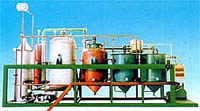
Germ removal, grinding of corn with removed germ, germ pressing, meal extraction, refining, bleaching, deodorization, winterization of corn oil