
Executive Summary: Soybeans are a strategically important oilseed crop for Ukraine with continuously growing production and processing volumes. In 2024, a record harvest of approximately 6 million tons was achieved.
1. GENERAL CHARACTERISTICS OF SOYBEANS
Botanical Classification: Soybeans belong to the Fabaceae family. In cultivation, they are represented by one species - Glycine hispida Maxim., which is divided into 6 subspecies. The most important of these are: Manchurian, Slavic, Chinese, Indian, and Korean.
Morphological Features:
- Plant: Annual herbaceous plant with erect branching stem, 60-100 cm tall
- Root System: Taproot system, penetrates to depth of 1.5-2 m
- Leaves: Compound, trifoliate, fall off at maturity
- Flowers: Small, white or purple, predominantly self-pollinating
- Seeds: Weight of 1000 seeds - 100-250 g for most varieties
Biological Composition and Utilization
Chemical Composition:
- Protein: 35–45% of dry matter
- Oil: 18–22% in oilseed varieties
- Main Processing Products: Protein meal (animal feed) and vegetable oil
Global Utilization: 60–70% of world soybeans are processed for meal and oil production; the remainder is exported as whole beans for feed and seeds.
Agrotechnical Requirements: Soybeans require a warm growing season and moderate moisture supply. They are sensitive to frost in early stages and to drought during grain filling phase.
2. FEATURES OF SOYBEANS CULTIVATED IN UKRAINE
Ukraine's Natural Advantages:
- Soils: Fertile chernozems in central and southern regions
- Climate: Favorable conditions for soybean cultivation
- Potential: High potential yield capacity
Industry Development Dynamics
Area Expansion (2010–2020s): After 2014, soybean cultivation areas significantly increased as farmers switched to oilseed crops, with export demand stimulating this growth.
Technological Progress: Ukraine widely uses hybrids and varieties adapted to different climatic zones. Application of technological seeds, fertilizers, and plant protection products is growing.
Logistics and Markets: A significant portion of production is exported - both as whole beans and after processing.
3. ANNUAL PRODUCTION VOLUME DYNAMICS
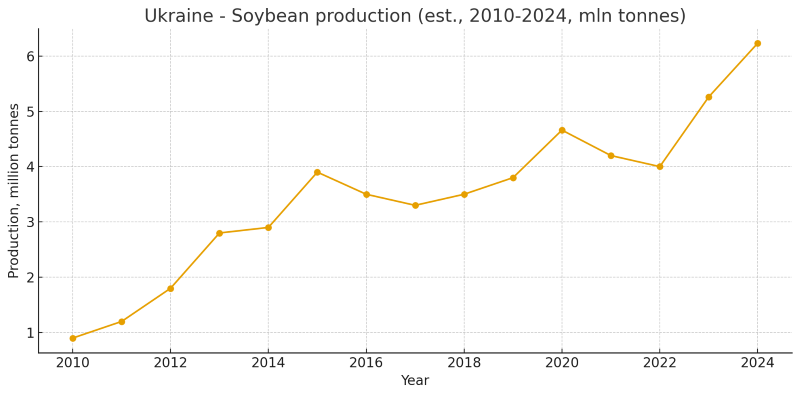
Soybean production chart in Ukraine (2010-2024)
Long-term Dynamics (2010–2023):
- 2010s: Production around 2 million tons
- Early 2020s: Stable 3–5 million tons depending on the year
- Growth achieved through expansion of cultivated areas and improved yields
Key Production Milestones
- ~2013: Approximately 2.8 million tons
- 2022–2023: 3–5 million tons (fluctuations due to military actions and weather conditions)
- 2024 (RECORD): ~6.0–6.2 million tons according to Reuters and industry sources
Production Summary: Since the late 2010s - steady growth in area and production, with volatility due to climate and geopolitical factors. 2024 became a record year with harvest of about 6 million tons.
4-5. SOYBEAN PROCESSING IN UKRAINE: CAPACITIES AND TRENDS
Production Capacities
According to USDA/FAS estimates (2018–2019):
- Total oilseed processing capacity in Ukraine: 18–19 million tons
- Soybean processing capacity: ~4.5–5 million tons
- Theoretical ability to process most of the domestic harvest
Actual Volumes and Current Trends
Processing Growth (2023–2024): Ukraine is increasing processing of oilseeds, including soybeans and rapeseed. This compensates for the decline in sunflower harvest and provides export of higher value-added products.
Export Opportunities: Growing demand from the EU and other regions for oil and meal makes processing economically attractive provided logistical challenges are addressed.
6. PROSPECTS FOR SOYBEAN PROCESSING
Factors Determining Industry Development:
- Harvest and Areas: High 2024 indicators create raw material base
- Production Capacities: Existing capacities allow processing 5–6 million tons
- Economic Benefit: Processing vs export of raw beans
- 2025 Forecast: Potential for record harvest with favorable weather
7. CONCLUSIONS AND RECOMMENDATIONS
Main Conclusions
Ukraine has transformed into a significant soybean producer in recent years: from 2–3 million tons (early 2010s) to a record 6 million tons in 2024. Existing processing capacities (approximately 4.5–5+ million tons) make processing a logical way to increase added value.
Recommendations for Processors and Investors
- Invest in flexible equipment allowing switching between different oilseed crops
- Improve quality of output products (meal/oil) to meet export requirements
- Develop logistical chains for efficient access to international markets
- Implement modern processing technologies to increase profitability
Sources Used
- Reuters — reports on record soybean harvest in Ukraine (2024 data, estimate ~6.2 million tons)
- AgManager / State Statistics — historical series of soybean production by year (2013–2024)
- USDA / FAS — reports on processing capacities in Ukraine (estimates ~4.5–5 million tons for soybean processing)
- UkrAgroConsult, APK-Inform, Tridge — industry reviews on oilseed processing and export growth